art statement
Legrady bio
Legrady cv
Legrady CCCA
Art Database
National Gallery
of Canada
collection
31 works
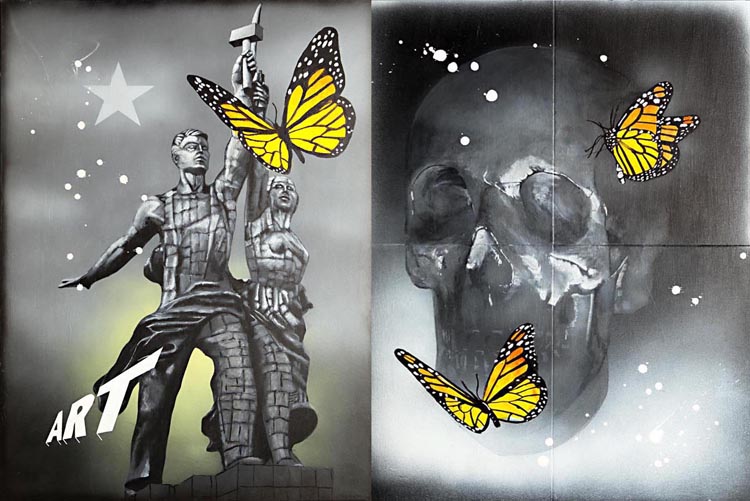 METAMODERNISM At its core, metamodernism is about oscillation: it moves back and forth between seemingly opposite attitudes like sincerity and irony, hope and doubt, progress and skepticism. In cultural theory, metamodernism is widely considered the dominant framework that comes after postmodernism. It functions as a blend of the two eras, oscillating between the optimistic ideals of modernism and the cynical irony of postmodernism to create a mindset of "ironic sincerity". Key idea: Instead of choosing one worldview, metamodernism embraces both at once: It allows for genuine emotion and meaning (like modernism), while still being aware of uncertainty, contradiction, and constructed reality (like postmodernism). How it differs: Modernism (late 19th–mid 20th century) Believed in progress, truth, and grand narratives (e.g., science, reason, utopias). Postmodernism (late 20th century) Questioned everything—truth, meaning, authority—often using irony, parody, and skepticism. Metamodernism (21st century) : Acknowledges that certainty is impossible, but chooses to care anyway. Characteristics: “Informed sincerity” — being earnest while knowing things are complex or uncertain Oscillation — shifting between optimism and doubt Reconstruction of meaning — trying to build purpose after postmodern deconstruction Emotional openness — less detached, more vulnerable than postmodernism Pragmatic idealism — striving for better futures without believing in perfect solutions Le métamodernisme est un mouvement culturel, philosophique et artistique apparu au début du XXIe siècle en réponse au modernisme et au postmodernisme, et comme une évolution au-delà des deux. Le terme a été popularisé par les théoriciens culturels Timotheus Vermeulen et Robin van den Akker au début du XXIe siècle. Au fond, le métamodernisme repose sur l'oscillation : il va et vient entre des attitudes apparemment opposées, comme la sincérité et l'ironie, l'espoir et le doute, le progrès et le scepticisme. En théorie culturelle, le métamodernisme est largement considéré comme le cadre dominant qui succède au postmodernisme. Il fonctionne comme un mélange des deux époques, oscillant entre les idéaux optimistes du modernisme et l'ironie cynique du postmodernisme, pour créer un état d'esprit de « sincérité ironique ». Idée clé Plutôt que de choisir une seule vision du monde, le métamodernisme les embrasse toutes les deux à la fois : il permet une émotion et un sens authentiques (comme le modernisme), tout en restant conscient de l'incertitude, de la contradiction et de la réalité construite (comme le postmodernisme). Ce qui le distingue Modernisme (fin du XIXe – milieu du XXe siècle) : croyance dans le progrès, la vérité et les grands récits (par exemple, la science, la raison, les utopies). Postmodernisme (fin du XXe siècle) : remise en question de tout — la vérité, le sens, l'autorité — souvent par l'ironie, la parodie et le scepticisme. Métamodernisme (XXIe siècle) : reconnaît que la certitude est impossible, mais choisit malgré tout de se soucier des choses. Caractéristiques
|